The worst call to make is the one you make at 4 p.m. on a 104-degree Friday, when the walk-in has been climbing all afternoon, the compressor is short-cycling, and you have a full weekend of reservations already on the books. By then you are not shopping for cold storage. You are triaging a loss.
That call happens somewhere in California every summer week. It happens to restaurants whose walk-ins were sized for 90-degree days, not 110-degree days. It happens to grocers whose back-of-house cases were never meant to hold July weekend volume. It happens to caterers running three events with one cooler, and to produce distributors moving stone fruit on a clock measured in hours.
The math is unforgiving. A single walk-in failure can write off five figures of inventory before anyone notices the temperature log drifting. Then come the secondary costs: an unplanned health inspection, a menu you have to shorten, orders you have to refuse, and customers who quietly decide to go somewhere more reliable. Spoilage is the number on the invoice. Lost confidence is the number you never get to see.
This post is about the part most operators skip: adding cold capacity before the season squeezes you, so summer becomes a logistics question instead of an emergency.
Why Summer Breaks Refrigeration That Worked Fine in April
Permanent refrigeration is designed around assumptions. Summer in California quietly violates most of them at once.
- Ambient heat load. Every condenser works harder when the surrounding air is hot. Equipment that held 36°F comfortably in spring can drift during a sustained heat wave, especially if the condensing unit sits on a hot roof or in an unventilated corner.
- Door traffic. Peak season means the door opens two or three times as often, and each opening dumps warm, humid air inside.
- Volume beyond design. Overpacking a cooler restricts airflow, creating warm pockets and uneven temperatures even when the thermostat reads correctly.
- Deferred maintenance catching up. Dirty coils, a low charge, or a tired door gasket are survivable in mild weather. They are not survivable at 105°F.
Refrigeration rarely fails because of one thing. It fails because heat, traffic, and volume all peak in the same week.
Two Reasons to Bring in a Refrigerated Container
Overflow capacity, planned in advance
This is the proactive use case, and it saves the most money. You add a unit for the season so your permanent refrigeration never runs at the edge of its design:
- Staging beverages, produce, and prepped items for a weekend rush without cramming the walk-in
- Holding bulk purchases when pricing is good instead of buying week to week
- Giving a catering operation dedicated cold staging, separate from daily kitchen service
- Taking frozen inventory out of a shared cooler so the fresh side can breathe
Emergency backup, when something fails
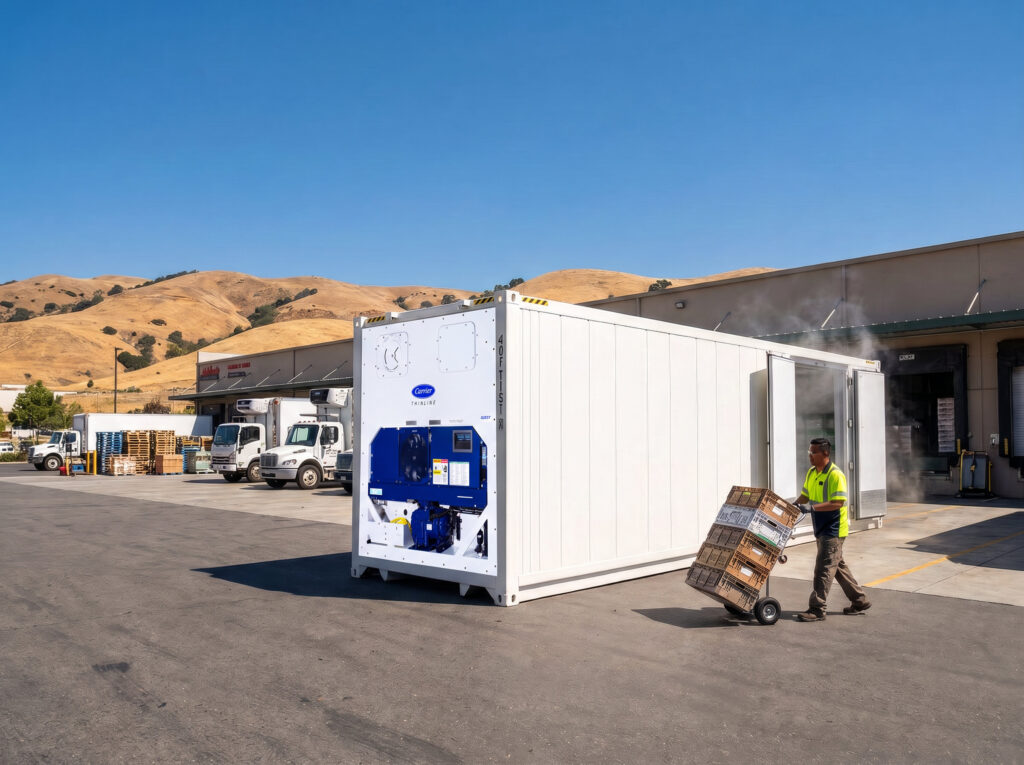
Even well-maintained equipment fails. A refrigerated container gives you somewhere to move product the same day, keeps you open while a repair is scheduled, and keeps your temperature records defensible. Cold Box Rents runs 24/7 service and fast delivery across California because refrigeration does not break during business hours.
Sizing: What Actually Fits in 10, 20, and 40 Feet
Sizing conversations go badly when they start with square footage. Start with pallets and cases.
10ft refrigerated container. The right answer for tight urban sites, small kitchens, and single-purpose staging — an alley, a small back lot, a courtyard behind a restaurant. Ideal when your constraint is placement, not volume. Rental pricing is by inquiry, since site conditions drive so much of it.
20ft refrigerated container. The workhorse for restaurants, grocers, caterers, and florists. Enough room for a full weekend of overflow or a serious bulk buy, still small enough for most commercial lots. Single-phase rentals start at $1,250 per month; the 3 phase dual voltage version starts at $799 per month, with purchase at $11,000.
40ft refrigerated container. For distributors, processors, packers, and multi-location operations — warehouse-scale cold storage that arrives on a truck. Rentals start at $850 per month, purchase $10,500. Needs more room to place and to deliver.
A useful rule: if you are choosing between two sizes, the larger one is almost always cheaper than a second delivery in six weeks.
Temperature, Power, and Placement — The Three Things to Get Right
Fresh versus frozen
Modern units hold a wide setpoint range, so the real decision is what you are storing.
- Fresh produce, dairy, and prepared foods generally live in the mid-30s to low-40s. Airflow matters as much as setpoint — leave clearance at the walls and do not block the evaporator.
- Frozen product wants 0°F or below, and holds better if you load already-frozen inventory rather than asking the unit to pull down warm product.
- Mixed use is a compromise, not a feature. If you need both fresh and frozen, two units set independently protect you better than one split down the middle.
Cooling units come from manufacturers you know from the cold chain — Carrier Transicold, Thermo King, Daikin, and Starcool — which matters when you need parts and service quickly.
Single phase versus three phase
This is the detail that delays more deliveries than anything else.
- Single phase is what most restaurants, small retail, and light commercial buildings have. Single-phase units exist for exactly this reason.
- Three phase is common in industrial buildings, warehouses, and processing facilities, and runs more efficiently under heavy load.
- When you need a transformer: if the unit is 460V and your service is 230V, a dual-voltage transformer bridges the gap. Cold Box Rents carries a Carrier modular 230V-to-460V transformer at $3,500, and offers Power Solutions if your site needs more than a straight plug-in.
Take a photo of your panel before you call. It saves a day.
Site prep
- Level, compacted ground — asphalt or concrete is best
- Airflow clearance at the condensing end, plus room to open the doors fully
- A drainage plan; refrigeration produces condensate
- Truck access: a 40ft unit needs a real turning radius and overhead clearance
- Power within reach of the unit’s cord, or a plan to get it there
How Far Ahead to Book
Summer inventory tightens as the season builds, and the last two weeks before a holiday weekend are the hardest.
- Planned seasonal overflow: three to six weeks out. That gives you time to confirm power, prep the pad, and pick the right size rather than the available size.
- Known event or promotion: book as soon as the date is on the calendar.
- Emergency: call immediately. Fast delivery and 24/7 service exist for this, but lead time always gives you more options.
Rentals require no long-term commitment, which is the point. You add capacity for the months you need it and stop paying when the season ends.
Get Ahead of It
One call is genuinely all this takes. Tell us what you are storing, what your power looks like, and where the unit needs to sit, and we will tell you what size makes sense — free estimate, no obligation. Fully licensed and insured, family owned and owner-operated, serving businesses across all of California.
Request a free quote or call 1-855-265-3911 to talk it through with someone who has done this before.
Browse current inventory , review sales and rental options , see what our service and maintenance coverage includes, or ask about Power Solutions if your site needs them. You can also contact us any time.