For most food and hospitality businesses in California, the six weeks between mid-November and New Year’s Eve carry a wildly outsized share of the annual number. Restaurants book out. Caterers run back-to-back corporate parties. Grocers and specialty markets hold more inventory than at any other point in the year. Event venues turn rooms three times a weekend. Florists move volume that would be unthinkable in February.
And nearly all of it depends on refrigeration that was sized for a normal Tuesday.
If a cooler fails in March, you lose a day. If it fails the Wednesday before Thanksgiving, or the morning of a 400-person holiday party, you lose the event, the deposit, the referral, and the client. There is no rescheduling a holiday.
Below is a practical plan: the capacity math, the specification details, and a countdown for when to have things in place.
What Goes Wrong in November and December
Turning away business you cannot store
This is the quiet one. A caterer declines a second Saturday event because there is nowhere to stage two at once. A restaurant skips the holiday prix fixe because cooler space is already committed. A market passes on a deal on holiday roasts because there is no room to hold them. None of it shows up as a loss on a P&L — it shows up as revenue that never existed.
Overpacked coolers that stop performing
Holiday volume tempts everyone to cram the walk-in. Blocked airflow creates warm pockets, the unit runs continuously trying to hold setpoint, and you get temperature excursions in a cooler whose thermostat reads perfectly fine. It is one of the most common causes of holiday spoilage, and it has nothing to do with equipment failure.
Compliance exposure at the worst possible time
Holiday operations mean more prepared food, more holding, more transport, and longer shifts. Temperature logs get looser exactly when volume makes them matter most, and a health-code problem in December is expensive twice over.
Single points of failure
Most operations have exactly one walk-in cooler and one walk-in freezer — a single point of failure sitting underneath your entire December revenue.
The Case for Guaranteed Overflow Capacity
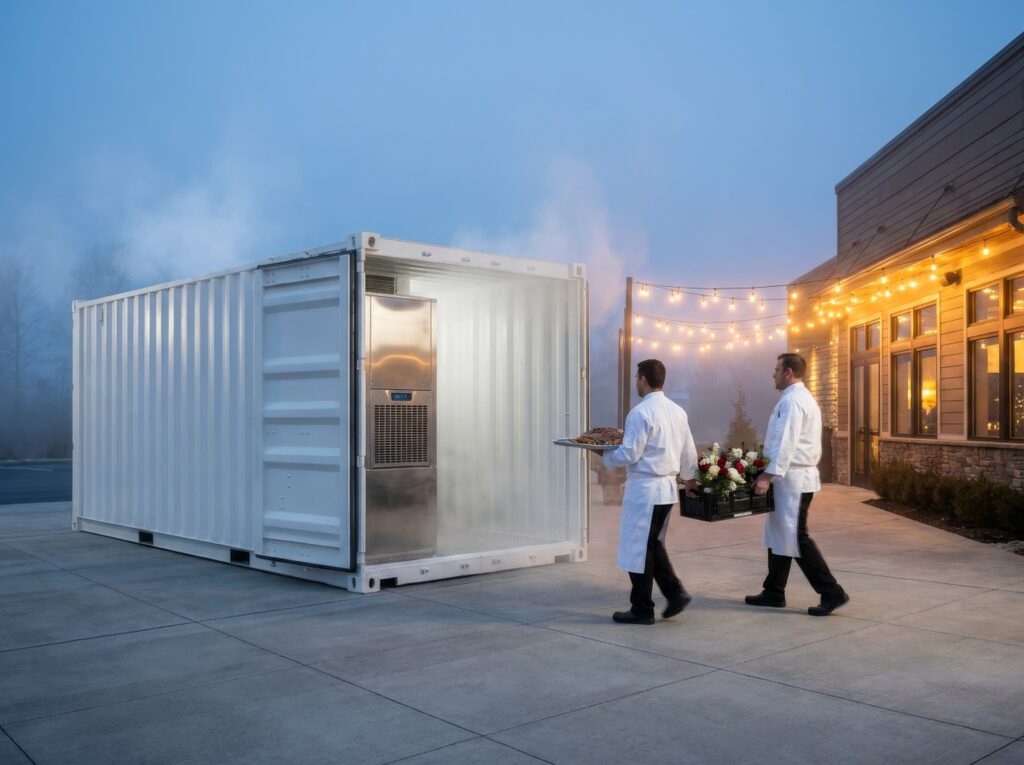
A refrigerated container placed on site for six or eight weeks solves several problems at once, and it does it without a long-term commitment.
- Dedicated staging. Prep and hold an entire event in its own cold space, without competing with daily service.
- Bulk buying leverage. Take pre-holiday pricing on proteins, produce and packaged goods instead of buying at peak spot rates.
- Separation of fresh and frozen. Move frozen inventory out of a shared cooler so the fresh side has room and airflow.
- Real redundancy. If your permanent cooler goes down, product moves the same hour instead of the same day.
- Room to say yes. Capacity is what lets you accept the extra event, the larger order, the party of thirty.
Cold Box Rents delivers across all of California, offers 24/7 service, and is fully licensed and insured — which makes this a low-risk addition rather than another thing to manage.
Sizing for Holiday Volume
10ft refrigerated container, single phase
Best for tight downtown restaurant sites, small markets, and florists. Enough dedicated cold space to take pressure off a single walk-in, small enough for an alley, a rear courtyard, or a couple of parking spaces. Rental pricing is by inquiry, since placement drives so much of it.
20ft refrigerated container
The default for most restaurants, caterers, event venues and specialty retailers. Holds a full weekend of event product or a serious inventory build, and still fits a typical commercial lot. Single phase rentals start at $1,250 per month; 3 phase dual voltage starts at $799 per month, with purchase at $11,000.
40ft refrigerated container
For restaurant groups, large venues, food retailers, and distributors supplying holiday demand. Rentals start at $850 per month, purchase $10,500. Plan for the footprint and the delivery access — this one needs real room to set down.
A simple heuristic: estimate your peak week, not your average week, then add the largest single event or order you would like to be able to accept. If that puts you between sizes, size up. A second delivery in December costs more than the difference.
Specification Details That Prevent Problems
Fresh versus frozen setpoints
- Fresh product — produce, dairy, prepared foods, floral — generally holds in the mid-30s to low-40s. Flowers are particularly sensitive; set to the product and keep airflow unobstructed.
- Frozen storage at 0°F or below is straightforward if you load product that is already frozen. Do not expect a holding unit to freeze warm product quickly.
- Running both? Use two units. Splitting one container between fresh and frozen compromises both, and holiday volume is the worst time to manage a compromise.
Cooling equipment comes from Carrier Transicold, Thermo King, Daikin, and Starcool — established cold-chain manufacturers, which matters when you need a part in December rather than January.
Power: check this before you book
- Single phase is what most restaurants, retail spaces and older commercial buildings have. Single-phase units are made for exactly these sites.
- Three phase shows up in larger venues, commissary kitchens, and industrial buildings, and handles sustained load more efficiently.
- Transformer: if the unit is 460V and your building provides 230V, a dual-voltage transformer bridges the difference — a Carrier modular 230V-to-460V unit is available at $3,500. If your power is uncertain, ask about Power Solutions before delivery day rather than after.
Photograph your electrical panel and send it with your quote request. It removes the most common source of delay.
Placement and site prep checklist
- Level, compacted ground — concrete or asphalt preferred
- Airflow clearance at the condensing end
- Full door clearance at the access end, with a safe path for staff carrying product
- Condensate drainage away from walkways and entrances
- Truck access confirmed: turning radius, gate width, overhead clearance
- Power reachable from the placement point
- On a shared or leased lot, confirm placement permission early
The Holiday Countdown
Availability tightens sharply through November. This is the schedule that works.
6 to 8 weeks out (late September to mid-October)
- Estimate peak-week volume and identify your gap
- Choose a placement location and confirm permission if the lot is not yours
- Check your power and note whether a transformer is likely
- Request a quote and reserve the unit
3 to 4 weeks out (late October to early November)
- Confirm the delivery date and window
- Prep the pad — clear, level, drain
- Confirm the electrical connection is ready
- Brief your team on where product will live and who logs temperatures
1 to 2 weeks out
- Take delivery and let the unit pull down to setpoint before loading
- Verify the setpoint with your own thermometer, not just the controller
- Load with airflow in mind and start your temperature log
- Save the 24/7 service number where the closing manager can find it
Emergency, any time. If a cooler fails mid-season, call immediately. Fast delivery and 24/7 support exist precisely for this. Lead time gives you more options, but an emergency is never a reason to wait until Monday.
Lock In Your December Capacity
One call handles this. Tell us what you are storing, roughly how much, what your power looks like, and where the unit would sit — and you will get a straight answer on size and cost. Free estimates, no long-term commitment on rentals, delivery anywhere in California, 24/7 support if anything goes wrong. Family owned and owner-operated, with decades of industry experience behind every delivery.
Request a free quote or call 1-855-265-3911 and we will get you sorted well before the rush.
Check current inventory , review rental and sales options , see our service and maintenance , or contact us .