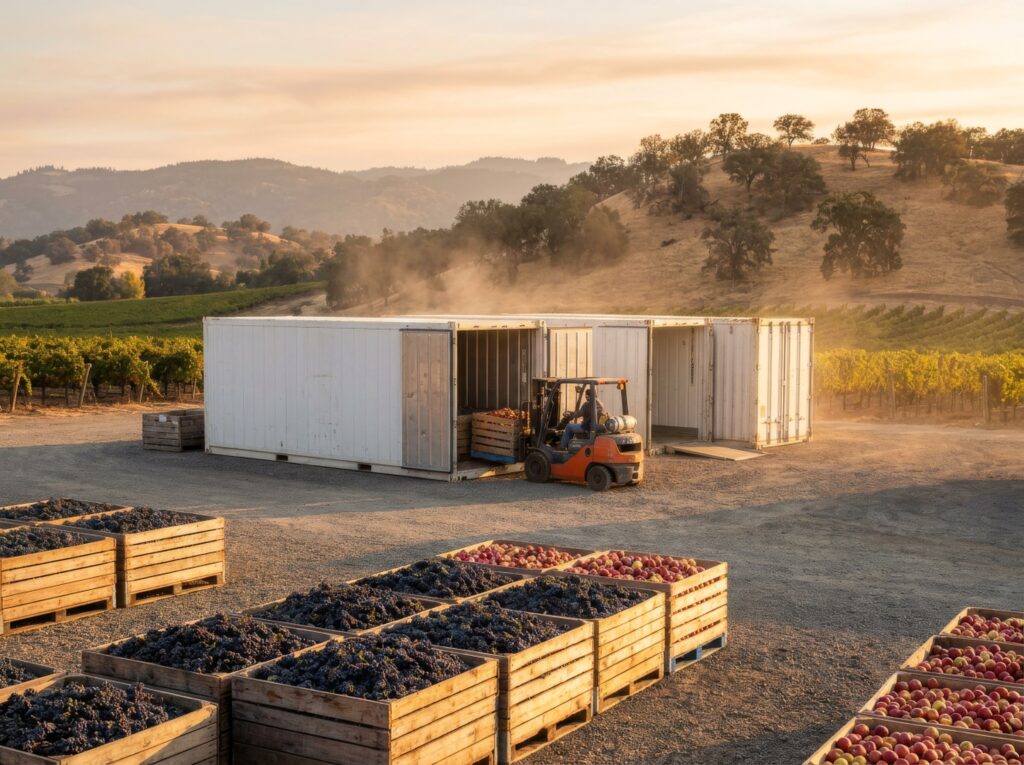
Every grower, packer, winemaker and processor in California runs the same uncomfortable calculation once a year. For ten or eleven months, your permanent cold storage is right-sized or even generous. Then harvest arrives, and for four to eight weeks you need two or three times the capacity you own.
There is no version of this where the fruit waits. Grapes come in when the numbers say they come in. Tomatoes, almonds, tree fruit, leafy greens, olives — all of it lands on a schedule set by weather and maturity, not by your dock space. When capacity runs out mid-harvest, every option is a bad one: hold product at ambient temperature and lose quality, slow intake and leave fruit past its window, truck it to a third-party facility at spot-market rates, or sell it down at a discount because you cannot hold it.
Each of those is a direct hit to the value of a crop you spent a full year growing. And unlike most operational problems, this one has a hard deadline — you cannot fix it in November.
The Real Cost of Being Short During the Window
The number is usually larger than operators estimate.
- Quality degradation. Field heat that is not pulled quickly shortens shelf life downstream. Product that reaches a buyer with reduced remaining life gets downgraded, rejected, or repriced.
- Throughput bottleneck. If you cannot store it, you cannot receive it. A cooler at capacity throttles the entire line behind it — trucks idling, crews waiting, intake backing up into the field.
- Emergency logistics premiums. Third-party storage and last-minute freight cost the most exactly when everyone in the region needs them at once.
- Contract risk. Missing a volume commitment to a distributor or retailer costs more than the shipment. It costs next season’s allocation.
- Overtime and rework. Compressed windows mean paid overtime and product that has to be re-sorted because it sat too warm.
Every one of those costs stems from a shortage that is entirely predictable. You know roughly when it will happen and roughly how short you will be.
Why Building for Peak Is the Wrong Answer
The instinct is to solve it permanently: build more cold storage. For most operations, that is the most expensive way to fix a six-week problem.
Permanent refrigerated space carries year-round costs — construction or lease, property tax, insurance, maintenance contracts, and the energy to keep space cold whether it is full or empty. Size it for your absolute peak and you pay twelve months a year for capacity you use for two. Size it for your average and you are back in the same shortfall every harvest.
Seasonal rental inverts the equation: bring in capacity when volume spikes, stop paying when it does not. Rentals through Cold Box Rents require no long-term commitment, so the unit matches the season instead of the fiscal year. Where the peak is genuinely permanent and growing, purchase is available too — 20ft 3 phase dual voltage at $11,000, 40ft 3 phase dual voltage at $10,500 — but that decision is better made after a season of knowing exactly what you need.
Matching Capacity to Your Operation
Wineries and breweries
Crush is the tightest window in the business. Containers get used for cold-soaking fruit, holding picked grapes overnight, staging bins ahead of the press, and buffering finished packaged product when the warehouse fills. Breweries use the same capacity for hop storage, cold-conditioning overflow, and seasonal release inventory. A 20ft unit near the crush pad often removes the single biggest bottleneck in the operation.
Growers and packing houses
The priority is pulling field heat fast and holding graded product until a truck is ready. A 40ft unit beside the packing line works as a staging cooler that keeps intake moving. If your operation is spread out, two 20ft units — one at receiving, one at shipping — can beat one large one.
Food processors
Processors need buffer on both ends: raw input waiting for the line, finished product waiting for pickup. Separating those into different units at different setpoints keeps a finished-goods backup from stalling raw intake.
Distributors and cold-chain logistics
Seasonal swings hit distribution as hard as production. Extra cold dock capacity keeps trucks turning and prevents cross-docking delays from becoming rejected loads.
Getting the Specification Right
How much space do you actually need?
Work in pallets, not cubic feet.
- 10ft refrigerated container, single phase. Small-lot storage, a single varietal, a specialty line, or a tight site where nothing larger fits. Pricing by inquiry, since site conditions vary widely at this size.
- 20ft refrigerated container. The most common harvest unit. Fits most agricultural and industrial sites, holds a meaningful share of a day’s intake, and is easy to place near the line. Single phase rentals start at $1,250 per month; 3 phase dual voltage starts at $799 per month.
- 40ft refrigerated container. For high-volume packing, processing, and distribution. Rentals start at $850 per month. Needs a longer, wider pad and clear truck access.
All pricing is a starting point. The right way to size this is a short conversation about volume, setpoint, and site, followed by a free estimate.
Temperature planning for the season
- Most fresh produce holds in the mid-30s to low-40s, but the commodity matters — some crops suffer chilling injury below a threshold, so set to the crop, not to the coldest available number.
- Frozen storage at 0°F or below works best when you load already-frozen product; a refrigerated container is a holding environment, not a blast freezer.
- If you need two setpoints, use two units. One unit split between fresh and frozen serves neither well.
- Load with airflow in mind. An overpacked container develops warm pockets no matter what the controller reads.
Units run cooling equipment from Carrier Transicold, Thermo King, Daikin, and Starcool, which keeps parts and service straightforward when you need them fast.
Power on agricultural and industrial sites
- Three phase is common on packing houses, wineries and processing facilities, and handles sustained load more efficiently. Dual-voltage 3 phase units cover most of these sites.
- Single phase covers smaller operations, outbuildings, and remote sites where three-phase service was never run.
- Transformer needed? If the unit is 460V and your service is 230V, a dual-voltage transformer bridges it — a Carrier modular 230V-to-460V unit is available at $3,500. For remote pads or sites without adequate service, ask about Power Solutions rather than improvising.
Placement and site prep
- Level, compacted, well-drained ground that will hold up under a loaded container
- Airflow clearance at the condensing end, full door swing at the other
- A condensate drainage path that does not run toward your dock or a walkway
- Delivery access wide enough for a truck and trailer, with no low branches or overhead lines
- Power within reach, or a plan to extend it safely
Book Before the Region Books
Seasonal demand across California peaks at the same time for everyone, so inventory is tightest exactly when harvest starts.
- Known harvest or crush window: six to eight weeks ahead. Highest-leverage move available, and reserving early costs nothing.
- Volume surprise mid-season: call the same day. Fast delivery and 24/7 service exist for this, but peak availability is finite.
- Multi-site or multi-unit needs: earlier still, so units can be staged in sequence.
Plan This Season’s Capacity Now
Tell us your crop or product, target temperature, volume, and site conditions. We will tell you what configuration makes sense and what it costs — free estimate, no obligation, no long-term commitment on rentals. Family owned, owner-operated, decades of industry experience, fully licensed and insured, serving all of California.
Get a free quote or call 1-855-265-3911 and we will work through the sizing with you.
See current inventory , compare rental and purchase options , review service and maintenance , or contact us .